Abstract
Abstract: With the global debate surrounding genetically modified (GM) products, maize presents a unique intersection of scientific consensus and cultural heritage. In Mexico, where maize is a cultural cornerstone, the government recently restricted GM maize for human consumption under the precautionary principle. In this paper, we assess whether exposing participants to culturally framed information about GM maize causally influences their support for the ban, or if deeply ingrained cultural identity dictates their preferences regardless of framing. By analysing experimental survey data from 498 Mexican residents, we examine the public's policy attitudes across factual and cultural narratives. Although our initial results cannot specify a statistically significant change in policy support based solely on the framing condition, introducing strict socio-economic controls reveals the underlying treatment effect. By isolating pre-existing attitudes towards GMOs and the baseline importance of maize culture, our findings demonstrate that specific cultural narratives systematically amplify risk aversion and elevate support for the ban.
Introduction
Genetically modified (GM) products, including maize (corn), have sparked significant debate globally. While the scientific community largely agrees that GM crops do not pose substantial health or environmental risks (National Academies of Sciences, Engineering, and Medicine, 2016), public scepticism remains prevalent (Scott et al., 2018). The concerns are particularly pronounced in Mexico, where maize is not just a staple food but a cultural cornerstone.
In response to fears about unintended and irreversible consequences, the Mexican government recently banned GM maize for human consumption (Lipton, 2024). This decision reflects a broader tension between scientific evidence and cultural preservation: while GM corn is widely accepted in countries like the United States, where debates focus on transparency and labelling (Sunstein, 2017), Mexico’s concerns are deeply rooted in protecting its biocultural heritage. The country’s diverse native maize varieties are seen as vital to its national identity, and potential contamination by GM strains threatens this legacy.
The debate over GM maize is further complicated by differing perceptions of risk, which are similarly influenced by cultural and cognitive factors. Sunstein (2005) discusses the availability heuristic, where risks that are more readily recalled—such as those associated with GM foods—are perceived as more significant, even in the absence of proportional evidence. This cognitive bias can amplify public fears and drive policy decisions, like Mexico's GM maize ban, that prioritise caution over scientific consensus.
Cultural framing plays a crucial role in shaping these perceptions. Oyserman and Lee (2008) reveal that cultural priming can significantly influence psychological outcomes. Kitayama and Uskul (2011) further emphasise that cultural practices are deeply "embrained," making certain values highly resistant to change. However, as Kountouris and Remoundou (2016) note, cultural heritage significantly influences environmental preferences, suggesting that these values can still be strategically activated through policy framing.
The current research aims to fill a critical gap by investigating whether cultural framing actively influences Mexican attitudes toward GM maize and their support for the government's ban. This study examines if cultural values can be isolated and activated to alter policy support, providing empirical evidence on the resilience and malleability of cultural identities in shaping environmental regulation.
Methods
To test this hypothesis, we designed a between-subjects online experiment with Mexican residents recruited through the Prolific platform. Participants were selected based on their self-identified nationality as Mexican and their current residency in Mexico. After applying standard exclusion criteria (such as attention checks), the final reliable sample consisted of 498 participants.
Participants were randomly assigned to one of two conditions. In the Factual (control) group, participants read standard, science-based information outlining the potential risks and benefits of GM maize. In the Cultural framing group, participants read similar factual information but presented alongside narratives emphasizing native maize's historical, identity-based significance in Mexico.
Following the reading, participants answered a comprehensive questionnaire. The primary outcome variable is the self-reported support for a ban on GM maize for human consumption across Mexico, measured on a 7-point Likert scale ranging from 1 (Strongly oppose) to 7 (Strongly support). To account for baseline variances during the analysis, the questionnaire also surveyed key covariates including pre-existing attitudes toward GMOs, the general perceived importance of maize culture, GMO familiarity, and demographic controls such as age (all primarily utilizing 7-point scales).
Results
We begin our analysis by examining the descriptive statistics of the primary variables included in our models. Table 1 outlines the central tendencies and distributions of policy support, the binary treatment assignment, and the surveyed pre-existing beliefs that act as covariates.
| Count | Mean | Std. Dev. | Min | Max | |
|---|---|---|---|---|---|
| Support for GM ban (1-7) | 498 | 4.56 | 1.70 | 1.0 | 7.0 |
| Cultural framing (Treatment) | 498 | 0.52 | 0.50 | 0.0 | 1.0 |
| Attitude toward GMOs (1-7) | 498 | 3.94 | 1.61 | 1.0 | 7.0 |
| Importance of maize culture (1-7) | 498 | 6.85 | 0.49 | 3.0 | 7.0 |
| Familiarity with GMOs (1-7) | 498 | 3.46 | 1.77 | 1.0 | 7.0 |
| Age (Years) | 498 | 29.49 | 7.19 | 19.0 | 65.0 |
We then estimated the causal effect of cultural framing on support for a GM maize ban using heteroskedasticity-robust Ordinary Least Squares (OLS) regressions. The first model provides an initial measure of the treatment effect, regressing only the framing assignment against the primary outcome:
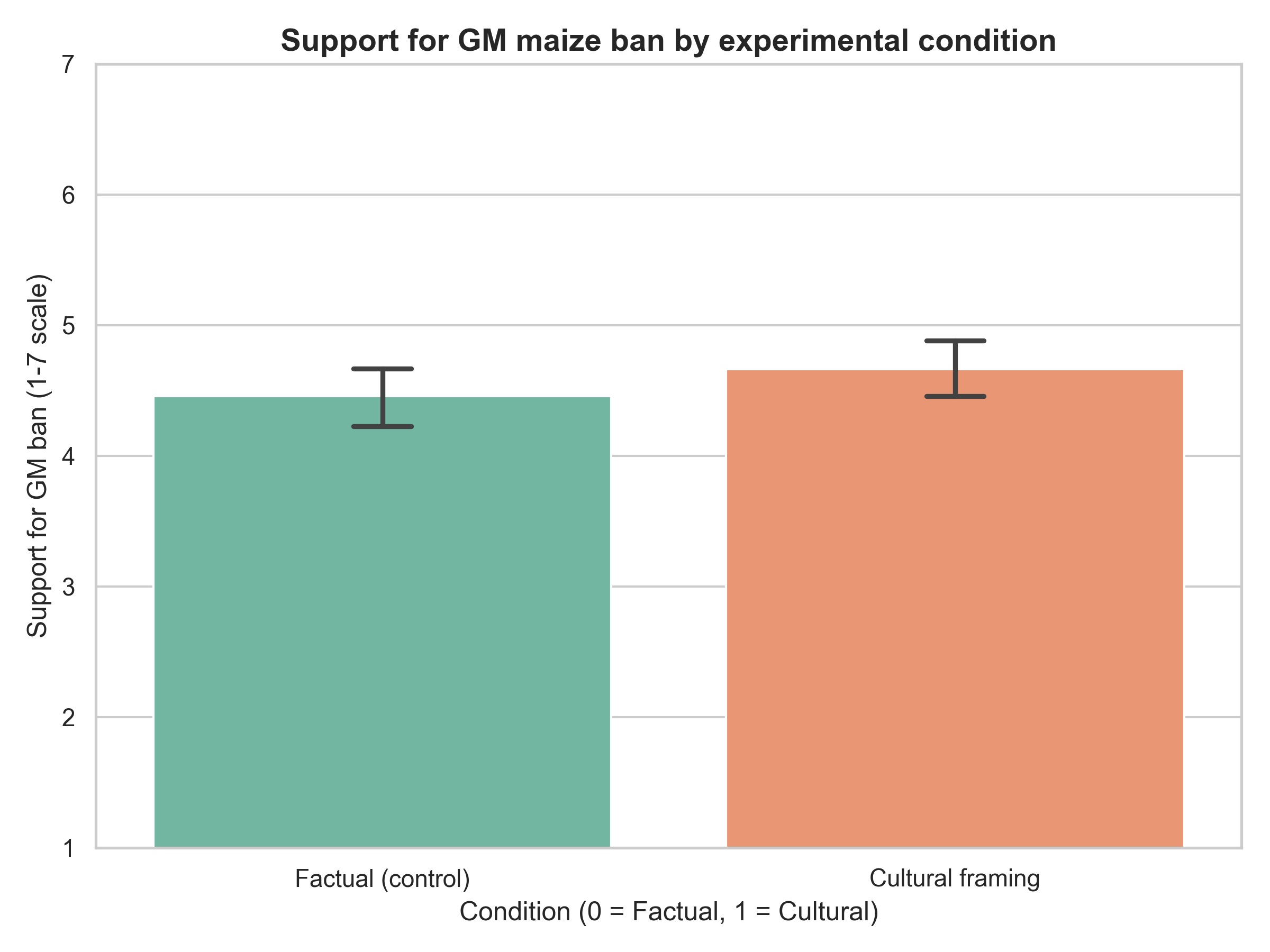
Our findings show that while the average support is intuitively higher under the Cultural presentation (Mean = 4.66) than the Control (Mean = 4.46), this initial difference is not statistically significant ($p = 0.173$). At first glance, this might imply that Mexico's biocultural identity is so deeply "embrained" that exposure to cultural framing does not meaningfully alter their existing views.
However, to better understand this relationship, we added a second model that includes demographic controls and heavily accounts for pre-existing variance. The estimating equation for this second model is:
As presented in Table 2, holding these covariates constant reveals a statistically significant treatment effect ($\beta_1 = 0.288,\ p = 0.031$). Including these variables controls for baseline opinions, such as pre-existing attitudes towards GMOs in general ($\beta_2 = -0.470,\ p < 0.01$) and the baseline importance of maize culture ($\beta_3 = 0.690,\ p < 0.01$). By accounting for these personal factors, we can see that the cultural framing influences policy support.
| Dependent variable: Support for GM ban (1-7 scale) | ||
| Primary model | Robustness check | |
| Cultural framing (Treatment) | 0.208 | 0.288** |
| (0.153) | (0.133) | |
| Attitude toward GMOs | -0.470*** | |
| (0.045) | ||
| Importance of maize culture | 0.690*** | |
| (0.189) | ||
| Familiarity with GMOs | 0.098** | |
| (0.039) | ||
| Age (Years) | 0.006 | |
| (0.009) | ||
| Intercept | 4.456*** | 1.033 |
| (0.108) | (1.398) | |
| Observations | 498 | 498 |
| R2 | 0.004 | 0.261 |
| Adjusted R2 | 0.002 | 0.253 |
| Residual Std. Error | 1.703 (df=496) | 1.473 (df=492) |
| F Statistic | 1.854 (df=1; 496) | 36.018*** (df=5; 492) |
| Note: | *p<0.1; **p<0.05; ***p<0.01 | |
Absence of risk perception bias
We also verified that the different experimental texts did not inflate perceptions of risk (Sunstein, 2005). We found no statistical difference in the perceived health risks ($p = 0.055$) or environmental risks ($p = 0.280$) between the two conditions. This guarantees that the targeted effect observed in the second model relates specifically to cultural preservation engagement rather than an accidental amplification of scientific concern.
Discussion
The results from our models highlight the complexities around the precautionary principle in Mexico. Initially, looking only at the naive averages (Model 1) suggests that cultural framing has little effect on public sentiment, matching the hypothesis that cultural identity is so deeply ingrained that framing does not significantly alter their views. However, adding socio-economic controls exposes the presence of a suppressor variable: while Mexican respondents do indeed have a strong baseline cultural connection (Kitayama & Uskul, 2011), providing an explicit cultural narrative further increases their support for the ban.
Accounting for covariates shows that support for the ban varies depending on prior attitudes. By isolating pre-existing opinions towards GMOs, the specific cultural narrative amplifies risk aversion, as suggested by Sunstein (2005). For policymakers working with deep-seated agricultural heritage, understanding this nuanced activation effect is important; environmental decisions driven by the precautionary principle cannot be communicated as purely scientific phenomena when the underlying public risk heuristics are so distinctly governed by cultural narratives.
References
Kitayama, S., & Uskul, A.K. (2011). Culture, mind, and the brain: Current evidence and future directions. Annual review of psychology, 62(1): 419-449.
Kountouris, Y., & Remoundou, K. (2016). Cultural influence on preferences and attitudes for environmental quality. Kyklos International Review for Social Sciences, 69(2): 369-397.
Lipton, M. (2024, February 27). Mexico is fighting to keep U.S. corn out of its tortillas. National Geographic.
National Academies of Sciences, Engineering, and Medicine (2016). Genetically Engineered Crops: Experiences and Prospects. Washington, DC: The National Academies Press.
Oyserman, D. & Lee, S.W. (2008). Does culture influence what and how we think? Effects of priming individualism and collectivism. Psychological bulletin, 134(2): 311-342.
Scott, S.E., Inbar, Y., & Rozin, P. (2016). Evidence for Absolute Moral Opposition to Genetically Modified Food in the United States. Perspectives on Psychological Science, 11(3): 315-324.
Scott, S.E., Inbar, Y., Wirz, C.D., Brossard, D., & Rozin, P. (2018). An Overview of Attitudes Towards Genetically Engineered Food. Annual Review of Nutrition, 38: 459-479.
Sunstein, C.R. (2005). Precautions against what? The Availability Heuristic and Cross-Cultural Risk Perceptions, Alabama Law Review, 75.
Sunstein, C.R. (2017). On Mandatory Labelling, with Special Reference to Genetically Modified Foods. University of Pennsylvania Law Review, 165(5): 1043-1095.